
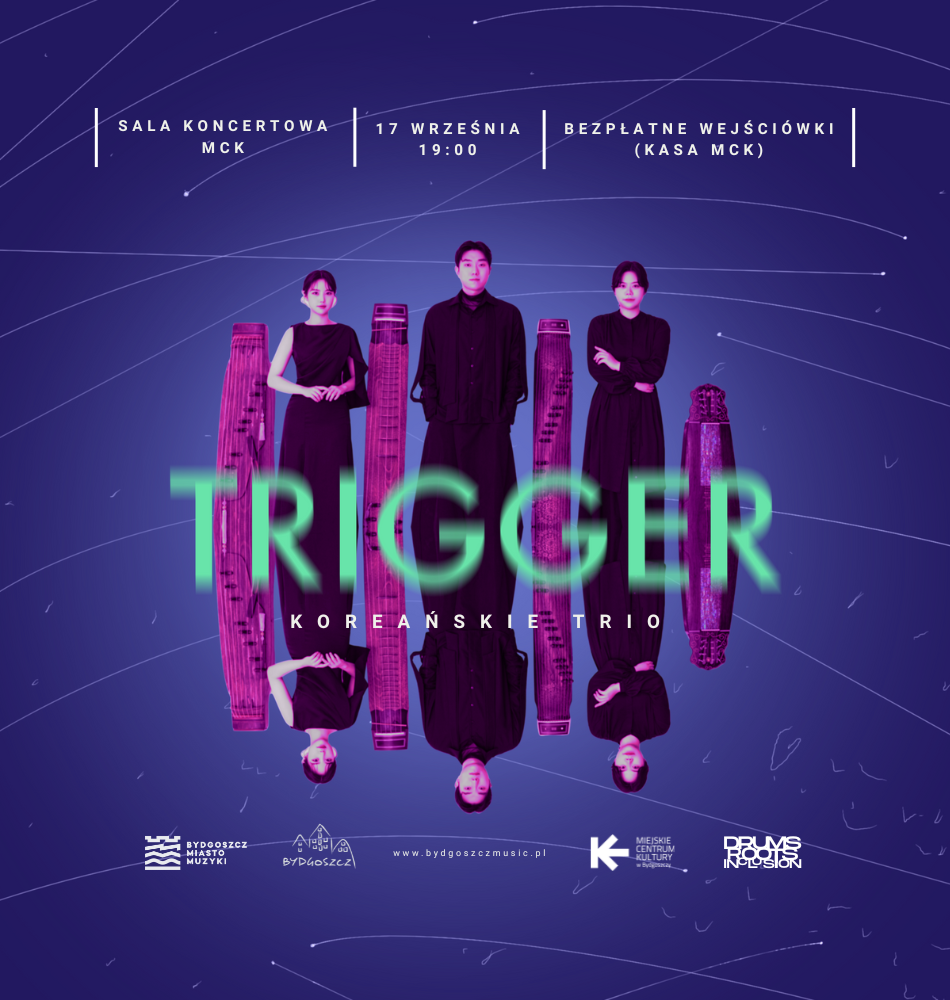
In a world where tradition and modernity often stand on opposite sides, Trigger finds common ground between them – the language of strings. Three exceptional artists: Songhee Lee (gayageum), Hyunjung Choi (geomungo), and Pilgoo Park (ajaeng) form a group that boldly and subtly redefines the sounds of traditional Korean music. Their original compositions, incorporating Korean aesthetics, improvisation, and minimalism, transform old sounds into new forms of expression.
Join us for another event in the Drums | Roots | Inclusion series – a performance by a Korean trio on September 17 at the Municipal Cultural Center in Bydgoszcz at 7:00 p.m.!
Free admission – free tickets available at the MCK box office
Founded in 2021, this Korean trio invites you to immerse yourself in the history, philosophy, aesthetics, and Korean perception of beauty through the rich and diverse music of their country. The group’s name reflects its mission to unleash new ways of experiencing Korean music, pushing boundaries while remaining rooted in their cultural identity.
In 2025, they will tour Europe as representatives of Daegu – UNESCO City of Music. With evocative soundscapes and dynamic stage presence, Trigger invites audiences around the world to discover the timeless beauty and contemporary relevance of Korean string music.
Mimesis refers to “representation” or “imitation.” Traditional Korean music has long drawn its aesthetic essence from the life force that arises from the encounter between humans and nature. The performance interprets the mimetic nature of Gugak—its ability to reflect life—through the sounds of the gayageum, geomungo, and ajaeng, offering a new representation of nature and spirit in a contemporary form.
Program:
Memento Mori
A hybrid phrase combining the Latin memento mori (“remember death”) with mori, a Korean term meaning rhythmic cycles. The title translates as “remember the rhythm.” The piece emphasizes the expressiveness of Korean string instruments, which move energetically and variably in diverse rhythms.
No
“No” means “No.” I am not fully myself. Our musical identity is shaped not only by what is inside us, but also by what we absorb from the world around us. The song pays tribute to external influences while denying internal distortions—awakening a new form of beauty through paradox.
Tunnel
Every musician travels through their own tunnel toward an invisible future, searching for their own sound. Tunnel captures the raw emotions and desires that drive this search, delicately expressing uncertainty and longing for youth through music.
Hyeonhyeon, Seonseon (Resonance and Virtue)
The string (hyeon, 絃) vibrates and the sound fades away. However, if we listen carefully, the hand remains on the string and the reverberation continues. This is the act of capturing nonghyeon – the fading nuance of pulling up the tone. When the sound creates a wave, the line (seon) takes on the character of goodness (seon).
Seomgwang (蟾光) (Moonlight)
Seomgwang, literally “toad light,” is inspired by the Korean children’s folk song Dugeob-a Dugeob-a. The dreamy melody of the gayageum represents the moonlight, intertwined with the resonant tone of the ajaeng and the grounding pulse of the geomungo.
Pokryu (暴流) (Torrential Flow)
Pokryu is a Buddhist term meaning bonno, or inner turmoil. The work symbolizes liberation from suffering, expressing the artist’s personal and aesthetic language as a natural flow of the mind.
